
📖 6 min read
Selling a home is one of the largest financial transactions most people will ever make. Traditionally, homeowners rely on licensed real estate agents to handle pricing, marketing, negotiations, and paperwork. However, an increasing number of sellers are choosing to sell independently — often referred to as For Sale By Owner (FSBO).
But is selling your home without an agent truly worth it? Can you really save money? Or does the risk outweigh the reward?
In this detailed guide, we’ll break down the pros, cons, and full cost comparison of selling your home without an agent so you can make an informed decision in 2026.
What Does “Home Sale Without an Agent” Mean?
Selling without an agent means you, the homeowner, take responsibility for:
- Pricing the property
- Marketing and listing
- Hosting showings
- Negotiating with buyers
- Managing legal paperwork
- Coordinating inspections and closing
You essentially act as your own real estate representative.
Why More Homeowners Are Considering FSBO
Several factors are driving this trend:
- Rising property prices
- Desire to save on commission
- Access to online listing platforms
- Greater availability of legal documentation templates
- Increased real estate knowledge among homeowners
Technology has made it easier to market properties independently, but the process still requires significant effort.
The Biggest Advantage: Commission Savings
Typical Agent Commission Structure
In many markets, total real estate commission ranges from 4% to 6% of the sale price.
For example:
- Home sells for ₹1 crore
- 5% commission = ₹5 lakh
That’s a significant amount — and the primary reason sellers consider FSBO.
By selling independently, you could potentially save thousands or even lakhs in commission fees.
However, the savings are not always as straightforward as they seem.
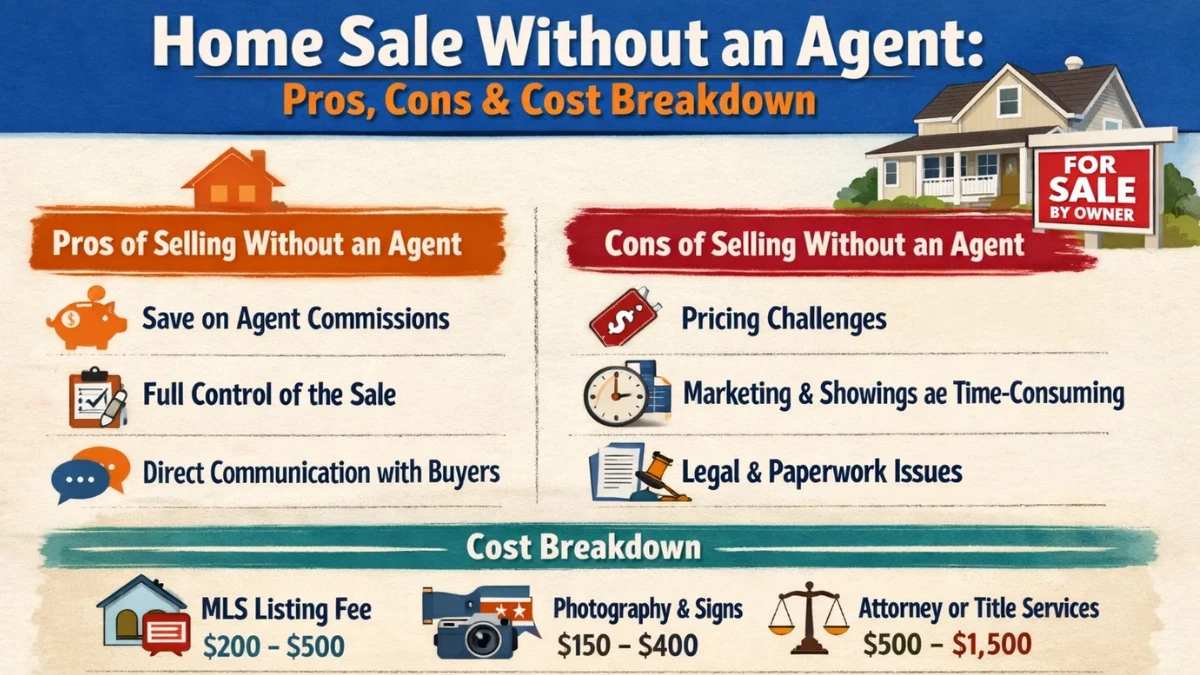
Pros of Selling Without an Agent
1. Save on Commission Fees
This is the most obvious benefit. If you successfully close the sale yourself, you avoid paying listing agent commission.
2. Full Control Over the Process
You control:
- Pricing strategy
- Showing schedules
- Negotiation style
- Marketing approach
There’s no intermediary filtering communication between you and buyers.
3. Direct Buyer Communication
Some sellers prefer speaking directly with buyers to:
- Answer questions personally
- Explain property details clearly
- Build trust
Direct interaction may speed up negotiations in certain cases.
4. Flexible Marketing Decisions
You choose where and how to list your property — online portals, social media, local classifieds, or personal networks.
Cons of Selling Without an Agent
1. Risk of Pricing Incorrectly
Pricing is one of the most critical aspects of selling.
- Overpricing can cause your home to sit unsold.
- Underpricing can result in lost profit.
Professional agents use market data, comparables, and demand trends to determine optimal pricing.
Without expertise, sellers may miscalculate.
2. Limited Market Exposure
Agents typically:
- Access Multiple Listing Services (MLS)
- Leverage professional networks
- Market through established channels
Independent sellers may struggle to reach the same buyer pool.
3. Negotiation Challenges
Experienced agents:
- Handle objections professionally
- Manage multiple offers
- Understand buyer psychology
- Protect your interests during negotiations
Without negotiation experience, sellers may:
- Accept lower offers
- Concede too quickly
- Miss strategic opportunities
4. Legal Risks and Paperwork Complexity
Property transactions involve:
- Sale agreements
- Disclosure forms
- Legal compliance documentation
- Title transfer coordination
Mistakes in paperwork can cause:
- Delays
- Financial penalties
- Legal disputes
Hiring a real estate attorney may become necessary.
5. Time and Effort Required
Selling a home is time-intensive.
Expect to handle:
- Phone inquiries
- Showings
- Marketing updates
- Buyer screening
- Inspection scheduling
- Closing coordination
If you have a full-time job, this can become overwhelming.
Cost Breakdown: Selling With vs. Without an Agent
Let’s compare both options clearly.
Selling With an Agent
Costs may include:
- 4–6% commission
- Minor staging costs
- Repair expenses
- Legal closing fees
Benefits:
- Professional pricing
- Wider exposure
- Expert negotiation
- Legal protection
Selling Without an Agent (FSBO)
Potential costs include:
- Professional photography
- Online listing fees
- Marketing expenses
- Legal consultation fees
- Home staging costs
- Buyer’s agent commission (often still required)
Important: Even in FSBO sales, many sellers still pay 2–3% commission to the buyer’s agent to attract more buyers.
So your total savings may be smaller than expected.
Example Cost Comparison
Assume property value: ₹1 crore
With Agent (5% commission)
- Commission: ₹5 lakh
- Net before other costs: ₹95 lakh
FSBO
- Buyer agent commission (2.5%): ₹2.5 lakh
- Marketing, photography, legal: ₹1 lakh
- Net: ₹96.5 lakh
Savings: ₹1.5 lakh
However, if the agent could have negotiated a higher sale price (for example ₹1.05 crore), you might actually earn more with professional representation.
Hidden Risks of FSBO
- Emotional decision-making
- Difficulty qualifying serious buyers
- Security concerns during showings
- Reduced credibility in some markets
- Slower sale process
Buyers often negotiate harder with FSBO sellers, assuming they lack experience.
When Selling Without an Agent Makes Sense
You may consider FSBO if:
- You have prior real estate experience
- The market is extremely hot (seller’s market)
- You already have an interested buyer
- The property is in high demand
- You’re comfortable handling contracts and negotiations
When Hiring an Agent Is Better
You should strongly consider an agent if:
- The property is unique or complex
- The market is slow or competitive
- You lack time to manage the process
- You’re unfamiliar with pricing strategies
- You want maximum exposure
Professional representation often reduces stress and risk.
Hybrid Option: Flat-Fee or Limited-Service Agents
If full commission feels expensive, consider:
- Flat-fee MLS listing services
- Discount brokerage firms
- Limited-service agents
These options offer partial support at lower cost.
Psychological and Practical Factors
Beyond money, consider:
- Stress levels
- Time availability
- Legal confidence
- Negotiation comfort
- Risk tolerance
Saving money is important — but peace of mind also has value.
Market Conditions in 2026
In competitive markets with tech-driven buyers:
- Online marketing matters more than ever
- Professional photos are essential
- Pricing precision is critical
- Legal compliance is strictly enforced
The margin for error has become smaller.
Final Verdict: Is FSBO Worth It?
Selling without an agent can save money — but only if:
- You price correctly
- Market effectively
- Negotiate strategically
- Manage paperwork properly
For some sellers, it’s financially rewarding. For others, the stress and risks outweigh the savings.
In many cases, professional agents earn their commission by maximizing sale price and minimizing complications.
Conclusion
Home sale without an agent offers potential commission savings and full control — but comes with significant responsibilities and risks. Carefully weigh the cost savings against the expertise, exposure, and negotiation power an agent provides.
The right decision depends on your experience, time availability, market conditions, and financial priorities.
Smart sellers evaluate both the numbers and the workload before choosing their path.
FAQs
1. How much can I save by selling without an agent?
Potentially 2–6% of the sale price, depending on whether you still pay buyer’s agent commission.
2. Do I still need a lawyer if I sell without an agent?
In most cases, yes. A real estate attorney helps ensure contracts and legal documents are accurate.
3. Is FSBO harder in a slow market?
Yes. In competitive or slow markets, professional marketing and negotiation become more important.
4. Can I switch to an agent later if FSBO doesn’t work?
Yes. Many sellers start FSBO and later hire an agent if they struggle to attract buyers.
5. Do buyers trust FSBO listings?
Some do, but others prefer agent-listed homes due to perceived professionalism and smoother processes.